AI for legal research that opens the source first
Search 403 US courts and 15 primary corpora, then let the assistant read the full text of what it found before it writes a word. Every citation in the answer is the exact URL a tool actually fetched — so you can open it, read it, and disagree with it.
No credit card. Case law search is not paywalled — the free plan has it too.
What is AI legal research?
AI legal research is the use of a language model to find, read and synthesise legal authority — with the retrieval step done against real sources rather than the model’s memory. That distinction is the whole discipline. A model asked to recall case law produces citations that read perfectly and do not exist; a model handed a search tool, told to open the result and made to cite the URL it opened produces something a lawyer can actually check.
Finding the authority
Statutes, regulations, rules and decided cases — retrieved from primary sources rather than recalled from whatever the model absorbed during training.
Reading it in full
A search snippet is a pointer, not an authority. The full text of the exact page gets fetched and read before anything is asserted from it.
Synthesising across cases
Pulling the common question out of a stack of opinions, and saying where they agree, where they split, and which are binding rather than persuasive.
Citing so it can be checked
Every claim carries the URL it came from. The point of AI in legal research is not to be trusted — it is to be verifiable in seconds.
The failure mode everyone is worried about has a technical cause
Sanctioned filings with invented cases did not come from AI being unintelligent. They came from asking a model to recall authority instead of retrieve it. Recall produces a plausible-looking citation with nothing behind it. Retrieval produces a URL. Everything on this page is built around that one distinction.
Search 403 US courts the way a lawyer narrows
A dedicated research console, not a chat box pretending to be one. Filter the way you would in any real research tool, then hand the results to the assistant.

The research console, captured from the app — filters applied, results selected, ready for a brief.
Filters that match how research actually narrows
- Court picker grouped into eleven tiers — federal, state, military and tribal — so you can scope to a circuit rather than scroll a flat list of 403
- Date-filed range, for when the question is what the law was in a given window
- Precedential status: published, unpublished, errata, separate opinions or in-chambers
- Sort by newest, oldest, most relevant, or most cited — the last one is how you find the case everyone else is citing
- Cursor pagination that appends, so loading more never loses the results you were reading
- Open with no filters at all and you get the most recent Supreme Court opinions as a standing feed
Your query never enters the URL.Filters do, but the free-text search box is deliberately kept in component state — anything in a URL is captured by analytics, browser history and referrer headers, and a research query can name a client’s problem. An inbound link carrying ?q= is stripped on arrival.
What the court picker holds
- Supreme Court of the United States1
- Federal circuit courts of appeals13
- Federal district courts105
- Federal bankruptcy courts103
- Federal specialty courts21
- State supreme courts28
- State appellate courts62
- State trial courts6
- State attorney general opinions15
- Military courts11
- Tribal courts38
403 courts in total, indexed from CourtListener.
Select the cases. Get the brief that ties them together.
Tick the opinions that matter, and get a synthesis across all of them at once — the part of research that eats an afternoon and cannot be delegated to a search box.
Synthesis across 3 selected opinions
The common question
All three cases ask when a state court may exercise personal jurisdiction over an out-of-state corporate defendant, and each draws the line between specific and general jurisdiction differently.
How each case answers it
Fordholds that a causal “but-for” link between the forum contacts and the claim is not required, so long as the claim arises out of or relates tothe defendant’s deliberate market-serving conduct in the State.[1] Bristol-Myers Squibbforecloses the opposite move: a forum cannot aggregate resident plaintiffs’ claims to reach non-residents whose injuries had no connection to the State.[2] Daimlerfixes the general-jurisdiction anchor at the place of incorporation and principal place of business, rejecting an “at home wherever it does substantial business” theory.[3]
Distinctions and weight
All three are binding federal precedent. Ford is the most recent statement and expressly declines to overrule Bristol-Myers Squibb[2]— read together, the relatedness inquiry is broader than causation but still requires a genuine forum connection on the plaintiff’s own claim
Citations
- [1]Ford Motor Co. v. Montana Eighth Jud. Dist. Ct., 592 U.S. 351 (U.S. 2021). courtlistener.com
- [2]Bristol-Myers Squibb Co. v. Superior Ct., 582 U.S. 255 (U.S. 2017). courtlistener.com
- [3]Daimler AG v. Bauman, 571 U.S. 117 (U.S. 2014). courtlistener.com
What the brief is instructed to do
The prompt behind this is short and mostly negative, which is the point. It identifies the common legal question, explains how each case answers it with a numbered footnote, notes splits, distinctions and precedential weight, and closes with a citations list.
- Up to ten opinions in one synthesis, each hydrated to its full text before the model sees it
- Footnotes are inline as it goes — [1], [2] — so you can trace any sentence back to a case
- Ends with a Citations section giving case name, reporter citation, court, year and URL
- Streams as it writes, so you can read the framing before the analysis lands
- Copy as markdown, or regenerate against the same selection
It is fenced to the cases you picked
Two instructions do most of the work: do not invent facts or case content, and do not cite any source outside the supplied opinions. If the selected cases do not address a coherent question, it is told to say so plainly rather than manufacture a through-line. A brief that admits the cases do not fit together is worth more than one that pretends they do.
Search, then open the page and read it
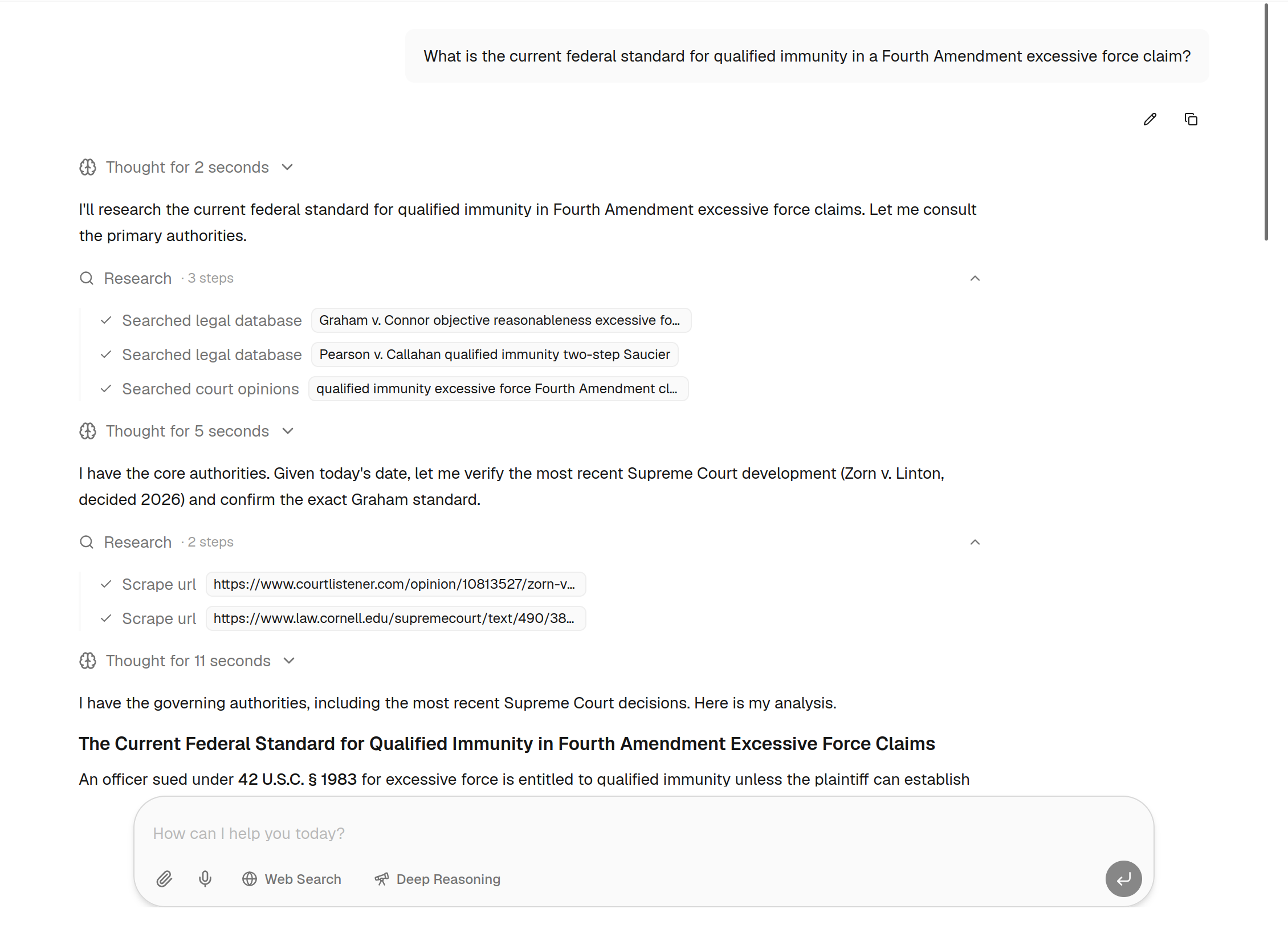
Inside a chat, research is a loop rather than a lookup. You can watch it run — each tool call, its arguments, and what came back.
USLegalSearch{ searchTerm: "18 USC 1341", corpus: "uscode" }→ 1 direct hit · 5 results
Discovery only. A snippet is never enough to support a claim.
scrape_url{ url: "law.cornell.edu/uscode/text/18/1341" }→ complete: true · 14,206 chars
Reads the full text of the exact URL the search returned — no keyword guessing.
search_scraped_document{ documentId: "doc_a91f…", query: "scheme to defraud" }→ 3 passages · chunk 2, 5
For oversized pages, it locates the passage instead of reading everything.
Only now does it write the answer
Every assertion is tied to a source that was opened and read in full, and the citation in the answer is the same URL the tool actually fetched.
The rule is written into the tools themselves
The legal search tool’s own description tells the model that snippets and direct-hit metadata are not sufficient support for a material legal claim, and that it must fetch the exact returned URL and inspect the full text before relying on it. The page-reading tool refuses to be used for discovery at all — it only accepts an exact URL, never a search term.
- Direct hits are separated from search results, so an exact citation lookup like 18 U.S.C. § 1341 lands on the section rather than near it
- Repealed provisions are filtered out of results before the model ever sees them
- Oversized pages come back chunked with an outline, and a second tool searches within them — so a 200-page opinion gets read at the passage, not skimmed at the top
- Only public http and https pages can be read; PDFs and other non-HTML documents return an error rather than a hallucinated summary
- Web search, when it runs, is treated as discovery too — its answer is explicitly not primary authority, and the underlying source still has to be opened
- Recalls authority from training data — the citation is generated, not retrieved
- Cannot tell you which source a proposition came from
- Equally fluent whether the case exists or does not
- No court filter, no date filter, no precedential status
- Your client material may be retained or used for training
- Retrieves from Cornell LII and CourtListener, then reads the page in full
- Every claim carries the URL the tool actually fetched
- Declines rather than fabricates when no source supports it
- Court, date, precedential status and citation-count filters
- Your documents stay private and are never used for training
Worried about confidentiality? Read what happens when client material goes into a consumer chatbot.
Fifteen primary corpora, and 161 vetted source hosts
Legal research AI is only as good as what sits behind the retrieval step. These are primary sources — the statute itself, the rule itself, the opinion itself — not a vendor's summary of them.
Searchable collections
Searched through the Legal Information Institute at Cornell Law School. Secondary material — dictionaries, wikis, annotations — is deliberately excluded from this index: a definition is a fine starting point and a poor citation.
161
vetted source hosts
Official government and court domains, university and non-profit repositories, each tagged by authority level and by what it actually publishes — legislation, regulation, judiciary, case law or international law.
10
countries covered
United States, United Kingdom, Canada, Australia, New Zealand, Ireland, Switzerland, South Africa, the UAE, plus a worldwide setting for cross-border questions.
51
US jurisdictions
All fifty states plus the District of Columbia, each mapped to its own legislature and court hosts — so a California question reaches leginfo, not a national aggregator.
Real-time web search — for the question whose answer changed last month — runs through Perplexity Sonar with an optional recency filter, and is on the Business plan.
What it looks like in practice
The same two surfaces, captured live rather than rebuilt — the research console, and a cited answer in chat.
How to use AI for legal research
AI in legal research replaces the first two hours, not the judgement at the end. Here is the loop that actually works, in the order it works in.
Ask the question you would ask a senior associate
Not keywords. The whole question, with the jurisdiction, the posture and what you are actually trying to establish. The assistant picks the corpus and the search terms from it — that is the part it is genuinely better at than you are at 11pm.
Narrow in the console when you know the shape of the answer
Once you know you need Ninth Circuit decisions after 2019, stop chatting and go to the search console. Court, date range, published only, sorted by most cited. Chat is for the open question; filters are for the closed one.
Select the cases that matter and generate the brief
Tick the four or five opinions that are actually on point and let it synthesise across them at once. This is where the time goes in real research, and where a per-document tool leaves you doing the joining by hand.
Open every citation before it goes anywhere near a filing
This is not optional and no vendor should tell you otherwise. The whole design here is to make that check take seconds rather than an afternoon — the URL in the answer is the page the tool read.
Which AI is best for legal research?
We are not going to tell you we are the best AI for legal research — every vendor in this category says that, and you have no way to check it from a landing page. Here are the six questions that actually separate them, including where the honest answer is not us.
Can you open every citation?
Not a footnote that looks like a citation — a link to the source, that resolves, on a domain you recognise. If a tool cannot show you where a proposition came from, the proposition is unusable in a filing.
Is retrieval real, or is it recall?
Ask the vendor which database the search hits and watch whether the answer names one. A tool that retrieves will tell you; a tool that recalls will talk about how good its model is.
Is your client material excluded from training?
This is a confidentiality question before it is a product question. It should be answerable in one sentence, in writing, without a sales call.
Can it work across a whole set of cases at once?
Most tools answer about one document. Real research is comparative — the value is in the synthesis across five opinions, including where they split.
Does it cover your jurisdiction properly?
National coverage often means federal plus a handful of big states. Check that yours is more than a search box pointed at Google.
Can you try it before a procurement cycle?
You will know within one real question whether a research tool fits your practice. Any pricing model that hides that behind a demo and a seat minimum is telling you something.
Where a legacy research platform still wins
If your practice depends on editorial infrastructure — headnotes, a key-number taxonomy, or a citator that tells you whether a case is still good law — a full-price research platform earns its money and this does not replace it. What this replaces is the hours before that: finding the cases, reading them, and working out what they collectively say.
For lawyers who are also the research department
Built for the people who do their own research — and, in the case of students, for the people learning how.
Solo practitioners
You do not have an associate to send the research to, and a five-figure platform subscription is not a rational spend against your matter volume. This is the version of the work that fits between two client calls.
Litigators
Sort by most cited to find the decision the other side will be citing, filter to published opinions in the right circuit, and synthesise the line of authority before you draft the brief.
Small firms and in-house counsel
Research that lands on whoever has the bandwidth, without a seat minimum or a procurement cycle. Everyone runs their own account and nobody waits to be provisioned.
Law students
Case briefs, doctrinal reading and moot preparation, with the source open beside the summary. Use it to read faster, not to avoid reading — the citations are there precisely so you check them.
What this is not
Every vendor in this category has a feature matrix with ticks all the way down. Here is the honest version, so you can rule us out in two minutes instead of two weeks.
No citator or good-law check
There is no Shepard's- or KeyCite-style signal telling you a case has been overruled, distinguished or criticised. Sort by citation count tells you a case is influential, not that it is still good law. You verify currency yourself.
No editorial headnotes or key numbers
You get the opinion text, not a publisher's syllabus, topic taxonomy or annotations. If your research method runs on key numbers, that method does not transfer here.
US case law only, for the search console
The case law console covers US courts through CourtListener. The assistant's source registry reaches ten countries, but there is no equivalent filtered console for UK, Canadian or Australian case law yet.
It does not clear you to file
Every citation still has to be opened and read by a lawyer before it goes into anything. That is not a disclaimer we are obliged to print — it is the actual, permanent shape of using AI in legal research.
If you need a citator and headnotes, keep the platform that gives you them. If what eats your week is finding the cases, reading them end to end and working out what they add up to, that is the part this was built for.
Case law search is on every plan, including free
Research is the part we did not paywall — the free plan gets the search console, the filters and the citations, capped at three questions a day. Paid plans lift the cap and add document review, drafting and deep reasoning. Real-time web search is on Business.
Free
Case law search, three questions a day.
Free forever. No card required.
- 3 legal questions per day
- File uploads up to 1MB (3 per message)
- Case law search access
Starter
Unlimited research questions for a solo practitioner.
- Unlimited legal Q&A
- 5 deep reasoning requests/day
- 10 document reviews/month
- 10 document generations/month
- File uploads up to 10MB (5 per message)
- Case law search access
- Email support
Pro
For a steady research and drafting load.
- Everything in Starter
- 15 deep reasoning requests/day
- 50 document reviews/month
- 50 document generations/month
- File uploads up to 25MB (10 per message)
- Priority email support
Business
Adds real-time web search and Cases.
- Everything in Pro
- Cases: shared chats, documents & matter context
- 30 deep reasoning requests/day
- Unlimited document reviews
- Unlimited document generations
- File uploads up to 50MB, unlimited attachments
- Real-time web search
- Dedicated live chat support
Cancel anytime. Secure payment byDodo Payments
AI legal research questions
Test it on a question you already know
That is the only honest way to evaluate a legal research tool. Ask it something you have already researched, and check every citation it gives you back.